What is Ante Post betting and how does it work?
Last Updated 1 week ago | By The GrandNational.org.uk StaffAnte-post betting simply means backing a horse well before a race is due to happen. In this case, that means days, weeks or even months ahead of the Grand National in April. The appeal of doing so is the price. Bookmakers offer bigger odds in advance, compared to what you’ll find on the day.
Those bigger odds come with a bit more uncertainty attached, and it’s worth knowing why. Backing a horse now means backing it to line up at all. Grand National trainers change their plans through the season, horses pick up injuries, and the Grand National runners list shifts constantly until only 34 are left standing. If your selection isn’t among them, your stake usually goes down as a loser.
That’s the balance to weigh up, and it’s easy enough to tip it back in your favour. Plenty of bookmakers offer Non-Runner No Bet closer to the race, which refunds your stake if your horse doesn’t run. The rest of this guide explains how it all works.
Grand National ante post betting
Many bookmakers price up the following year’s Grand National within minutes of the last one finishing, so there’s a market to bet on all year round.
With so many firms competing for custom, it’s a good time to be a punter. The bigger names set the benchmark, but it’s always worth shopping around, with bet365, Paddy Power, Betfair and Betfred among the options open to you.

Pros and cons of ante post betting on horse racing
There are good reasons to get on early, and good reasons to hold off. Much depends on the horse, the time of year and how much certainty you want for your money. Here’s how the two sides compare.
What are the advantages of Grand National ante-post betting?
Better odds
Getting bigger prices is the main draw of ante-post betting. A horse available at 33/1 in September might be 16/1 by the time the weights are published in February, and shorter still if it runs well in a trial. Bookmakers can afford to be generous this far out precisely because plenty of the horses they’re pricing will never make the line-up.
Getting ahead of the market
Ante-post betting rewards anyone willing to think a step ahead. Perhaps you reckon a particular horse will get a top jockey booked for it, or you fancy that a wet spring would suit one of the mudlarks in the field. Back that judgement early and you’ll be paid at a price that doesn’t yet reflect it.
Season-long interest
Backing a horse months out gives you something to follow through the winter. You’ll find yourself watching for its name at Haydock in November and Cheltenham in March, and there’s real enjoyment in seeing your price shorten as the race approaches.
No rule 4 deductions
If a horse is withdrawn shortly before a race, bookmakers apply what’s known as a Rule 4 deduction, taking a set amount out of winnings on the remaining runners to reflect the fact that the race has become easier to win. Rule 4 doesn’t apply to ante-post bets. The price you took is the price you get.

What are the risks of Grand National ante-post betting?
A non-runner is a losing bet
If your horse doesn’t line up, whether through injury, missing the cut or being aimed at another race, the bet is settled as a loser. You don’t get your stake back.
One way round this is to look for bookmakers offering Non-Runner No Bet, usually shortened to NRNB. Under that promotion your stake is refunded if your horse doesn’t run, which removes the main drawback entirely.
Unforeseen events can go against you
The fences and the distance stay the same, but very little else does. A horse you backed because it loves soft ground is in trouble if April turns dry. Jockeys switch mounts, trainers change targets, and a horse who wins a big trial in February can turn the whole market on its head.
Missing Grand National special offers
Some bookmakers save their best promotions for the days before the National, when the once-a-year money arrives. Faller insurance, extra places and money back if your horse finishes second have all been offered over the years, and they’re genuinely useful safety nets.
Your money is tied-up
A stake placed in autumn is gone until April. Not every bookmaker offers cash out on ante-post markets, so think twice before locking away money you might want to use elsewhere.

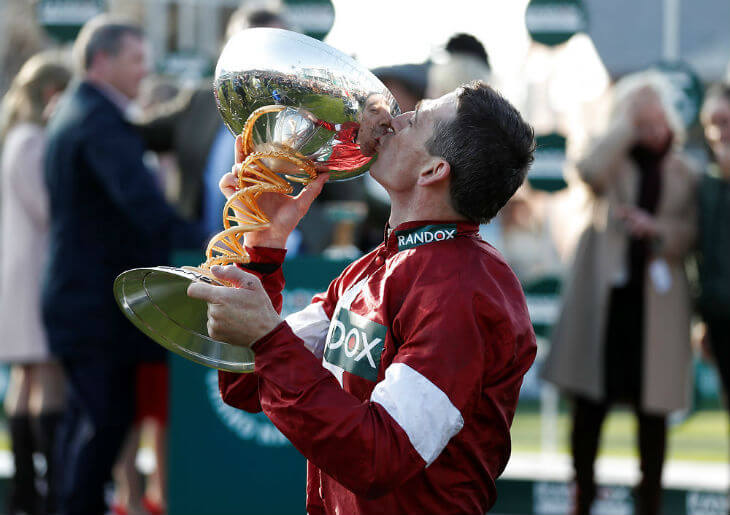
Grand National Festival – Aintree Racecourse, Liverpool, Britain – 14th April 2018 Davy Russell celebrates with a trophy after winning the 17.15 Randox Health Grand National Handicap Chase Action Images via Reuters/Matthew Childs @SCANPIX
Download our Grand National Betting Guide
What are the rules of Grand National ante-post betting?
The rules of Grand National ante-post betting are straightforward enough.
- A horse that doesn’t run is a losing bet. This is the big one. Ante-post selections that miss the final field aren’t treated as non-runners with stakes returned.
- You’re paid at the price you took. Take 20/1 in October and you’ll be paid at 20/1 even if the horse goes off at 8/1. Best Odds Guaranteed, which pays you at the bigger price if your horse drifts, almost always applies only to bets struck on the day of the race rather than ante-post.
- Non-Runner No Bet isn’t always available. Only some bookmakers offer it, and most only switch it on two to four weeks before the race, in the aftermath of the Cheltenham Festival. Once they do, the balance tips back towards the punter, since any bet on a horse that misses the final 34 is refunded. The trade-off is that prices usually tighten a little at the same time.

Using the betting exchanges for Grand National ante-post betting
Betting exchanges run a Grand National market all year round, much like a traditional bookmaker. The difference is that on an exchange you’re betting against other punters rather than against the firm, and you can bet on a horse to lose as well as to win. That second option is called laying.
If you back a horse on an exchange and it doesn’t run, you lose your stake just as you would elsewhere. But laying opens up another possibility. If you’re confident a particular horse won’t make the field at all, you can lay it and collect before a hoof has been put down.
The other advantage is the ability to trade your position, using a similar logic to cashing out your bet. If you backed a horse at 33/1 and a couple of good runs have brought it into 20/1, you can lay it at the shorter price and lock in a result regardless of what happens on the day.
This is more involved than a straightforward each-way bet, so it’s one for punters who fancy getting properly stuck in rather than anyone having their annual flutter.
Ante post betting example
- £10 win at 33/1 = £330 profit
- £10 lay bet at 20/1 = – £200 loss
You’ve now traded your £10 stake back and are risking nothing on the race. However, with the difference between the £330 winning and the £200 loss being £130 then this is the money you’ll win if your fancy goes onto win the Grand National.

Grand National 2027 ante-post favourites
| Grand National horses | Grand National latest odds | Implied Chance % |
|---|---|---|
| I Am Maximus | 12/1 | 7.7% |
| Soldier In Milan | 14/1 | 6.7% |
| Iroko | 16/1 | 5.9% |
| Jordans | 16/1 | 5.9% |
| Johnnywho | 25/1 | 3.8% |
| Nick Rockett | 33/1 | 2.9% |
| Fishery Lane | 33/1 | 2.9% |
| Kiss Will | 33/1 | 2.9% |
| Jagwar | 33/1 | 2.9% |
| Grangeclare West | 33/1 | 2.9% |
Grand National ante-post odds last updated on 24th September 2026. Odds subject to change. % can add up to more than 100% due to bookmakers margin.
Read Ante-Post Aintree Grand National Preview
Other useful pages
We hope you now feel more comfortable with the intricacies of ante post betting, so why not look at some more useful guides to answer any nagging questions you may have. Our bet calculator helps you see exactly how much your winning bets are worth, while our Tote betting guide, takes you through an alternative way of betting, which often pays out more than a normal bookmaker would.
Our Content
*We hope you enjoyed the selection of bookies we recommended! Just to be clear, grandnational.org.uk may collect a share of sales or other compensation from the links on this page.

You might also like…
The GrandNational.org.uk Staff