What is the going in horse racing?
Last Updated 4 weeks ago | By The GrandNational.org.uk StaffThe going in horse racing is the official description of the ground at a racecourse. It’s often one of the first things you’ll hear mentioned in any racing preview or commentary. It matters because some horses perform far better when they run on soft ground while others need it fast. Knowing which is which is one of the more reliable edges available to a punter.

What does the going mean?
The going means how soft or firm the racing surface is. The same set of descriptions is used across every turf course in Britain, so trainers, jockeys and punters all know roughly what to expect before they arrive.
What are the different types of horse racing Going?
There are seven official descriptions for turf racing in Britain, running from the fastest ground to the slowest.
Heavy
Prolonged periods of rain can result in the ground become saturated and defined as Heavy, which is the most severe of all the types of Going. This will only appeal to a select group of horses, with many struggling to make it round a gruelling course, and trainers often withdrawing their horses to protect them from overexertion or injury.
Soft
Soft going can occur during a wet period, particularly in colder months when the sun is slow to soak up the moisture in the ground. Race times will be noticeably slower than on Good ground, and Soft course specialists with plenty of stamina often thrive at the expense of their rivals who prefer better ground.
Good to Soft
A racecourse declared as Good to Soft, or Yielding in Ireland, contains a little more moisture than one considered Good. It is still considered suitable for the vast majority of horses, with only those favouring very fast or very slow ground at a real disadvantage. You can expect to see many racecourses declare their going as Good to Soft throughout the National Hunt season.
Good
As the name suggests, Good conditions are ideal for most horse races and the majority of horses will be comfortable running when the Going is declared as Good. The ground will contain some moisture without being too soft and you can expect large fields to be attracted to these conditions.
Good to Firm
You may see a racecourse declare the Going as Good to Firm during a dry period of weather. The ground would be expected to be fast in these conditions and would be better suited to sprinters in flat races than any National Hunt racing.
Firm
Firm going means a race is being run on fast ground, and it can occasionally be seen on the flat in a dry summer. It’s less common over jumps, where landing on unforgiving ground carries obvious risk.
Hard
If the going is described as hard, it means the ground is bone dry with no give at all. Racing almost never takes place on hard ground because of the jarring it causes, and courses will water or abandon instead. You will rarely see it declared.
Compound descriptions
You’ll often see something like “good to soft, good in places”. That means conditions genuinely vary across the track, and the clerk of the course has the discretion to say so. It’s worth reading properly, because “soft, heavy in places” is a very different proposition from plain soft.
The going in Ireland
Ireland uses its own descriptions, which matters at Aintree because a large share of the National field arrives from Irish tracks. The one that catches people out is yielding, which sits roughly where good to soft does in Britain. You’ll also see yielding to soft, good to yielding and soft to heavy. Treat yielding as the Irish equivalent of good to soft and the rest of the scale reads across sensibly.
All-weather tracks
Synthetic surfaces don’t use the turf scale at all. They’re described as fast, standard to fast, standard, standard to slow or slow, with standard being the norm.

How is the horse racing going determined?
The going is decided by the clerk of the course, the official responsible for the racing surface. They walk the track, assess it by hand and publish a description.
Since January 2009 the Rules of Racing have also required a GoingStick reading to be published alongside that description. The GoingStick is a handheld penetrometer: pushed into the turf, it measures both the force needed to penetrate the ground and the effort needed to shear it sideways, then combines the two into a single number on a scale of roughly 1 to 15. Higher figures mean firmer ground.
The important point, often misunderstood, is that the stick supplements the clerk’s judgement rather than replacing it. The official description is still a human call, informed by an objective reading, recent rainfall, drainage and the forecast.
When is the going published?
The going is published at the five-day entry stage, again at the 48-hour declaration stage, and then on the morning of racing, usually by around 7am after the clerk’s first walk of the course. It can be changed again during the day if conditions move.
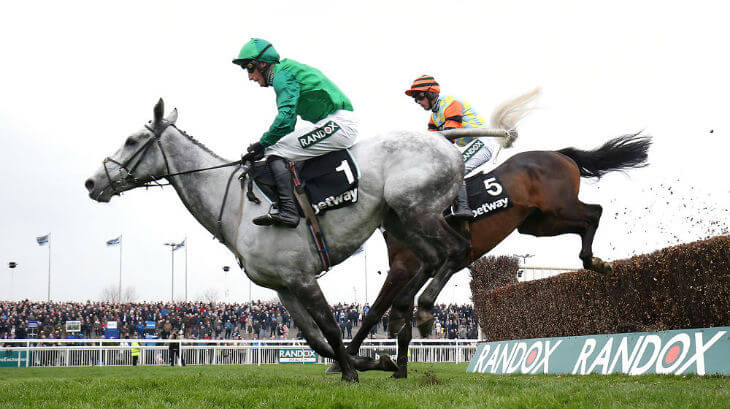
Grand National Festival – Aintree Racecourse, Liverpool, Britain – April 12, 2018. Might Bite ridden by Nico de Boinville in action (R) before winning the 14:50 Betway Bowl Chase. Action Images via Reuters/Jason Cairnduff TPX IMAGES OF THE DAY @SCANPIX
What is the going at the Grand National?
The going at the Grand National is confirmed on the morning of the race, though recent history gives a strong steer, with the most recent runnings of the Grand National leaning towards going that is good to soft.
| Year | Going | Winner |
|---|---|---|
| 2026 | Good to Soft | I Am Maximus |
| 2025 | Good to Soft | Nick Rockett |
| 2024 | Soft | I Am Maximus |
| 2023 | Good to Soft | Corach Rambler |
| 2022 | Good to Soft | Noble Yeats |
| 2021 | Good to Soft | Minella Times |
Good to soft in five of the last six is not a coincidence. Aintree waters the National course in the build-up when the forecast is dry, and clerk of the course Sulekha Varma adjusts through the week as conditions change. In both 2025 and 2026 the ground was watered during festival week to hold it at good to soft against warm, drying weather.
Two things to know when you read the racecard. First, Aintree declares its three tracks separately, so the Grand National course, the Mildmay chase course and the hurdle track can each carry a different description on the same afternoon. Second, extremes have become far less likely than the National’s reputation suggests.
Is the horse racing going important for picking winners?
The horse racing going can be crucial when picking race winners, particularly when it veers towards the extreme ends of possible conditions. Some horses are at their best when the ground is sodden, whereas others much prefer firmer ground. If you study a horse’s progress, you can use this to your knowledge.
The 2001 Grand National took place in tough conditions, with the Going declared heavy and many mudlarks proving popular in the days leading up to the race. Only four of 40 horses finished the race, led home by Red Marauder at odds of 33/1.
Does the going matter for picking winners?
The going matters most at the ends of the scale. Plenty of horses have a clear preference, and a form line achieved on heavy ground tells you little about how the same horse will run on good.
The obvious historical example is the 2001 Grand National, run on heavy ground after a soaking wet spring. Only four of the 40 runners completed, two of them remounted after a mid-race pile-up, something no longer permitted under the rules. Red Marauder came home at 33/1.
It’s a useful story about what saturated ground does to a race over four and a quarter miles. It’s also the exception. Aintree’s watering programme means a repeat is improbable, and for a modern National you’re usually assessing horses on good to soft rather than hunting for mudlarks.

Grand National Going FAQs
Find all the answers to the most commonly asked Going-related questions.
What does the going mean in horse racing?
The going in horse racing means the official description of the state of the ground, declared by the clerk of the course. Good sits in the middle of the scale, with softer ground described as good to soft, soft or heavy, and faster ground as good to firm, firm or hard.
What is yielding ground?
Yielding ground is an Irish going description, roughly equivalent to good to soft in Britain. You’ll see it regularly in the form of Irish-trained National runners.
What going is the Grand National usually run on?
The Grand National is usually run on good to soft. That was the going in five of the six runnings from 2021 to 2026, the exception being soft in 2024. Aintree waters the National course to keep conditions consistent, which makes very firm or very heavy ground unlikely.
How do I find the going before the race?
To find the going before the race, check the racecourse or the official going updates at the five-day entry stage and the 48-hour declaration stage, then again on the morning of the race. Aintree publishes separate descriptions for the National course, the Mildmay and the hurdle track, so make sure you’re reading the right one.
Does soft ground help or hurt my horse?
Whether soft ground helps or hurts your horse depends on the individual. Some are transformed by it and others need a faster surface, so look for a previous win on similar ground in its form. Our Grand National trends page covers the profile of a typical winner in more detail.
Download our Grand National Betting Guide
You might also like…
The GrandNational.org.uk Staff